

How does Monero's privacy work?
How Monero privacy works in practice
Monero is a privacy-focused cryptocurrency designed so that transactions do not publicly reveal the sender, the recipient, or the amount transferred. Unlike transparent blockchains, Monero makes privacy the default for all users, not an optional feature.
This article explains conceptually how Monero’s privacy works at a high level. If you want a technical breakdown of Monero’s internals, see How Monero works (details in plain English). Or for an even deeper technical explanation of ring signatures, stealth addresses, and RingCT, see Monero Privacy Explained: Ring Signatures, Stealth Addresses, and RingCT.
For a direct cross-coin privacy model comparison, see Monero vs Zcash vs Dash: Privacy Coins Compared.
For practical setup guidance before you transact, see Best Monero wallets.
The three privacy problems Monero solves
On a public blockchain, a transaction normally reveals three things: who sent the funds, who received them, and how much was transferred. Monero addresses each of these directly.
- Sender privacy: Who actually authorized the transaction
- Recipient privacy: Who controls the receiving address
- Amount privacy: How much value moved
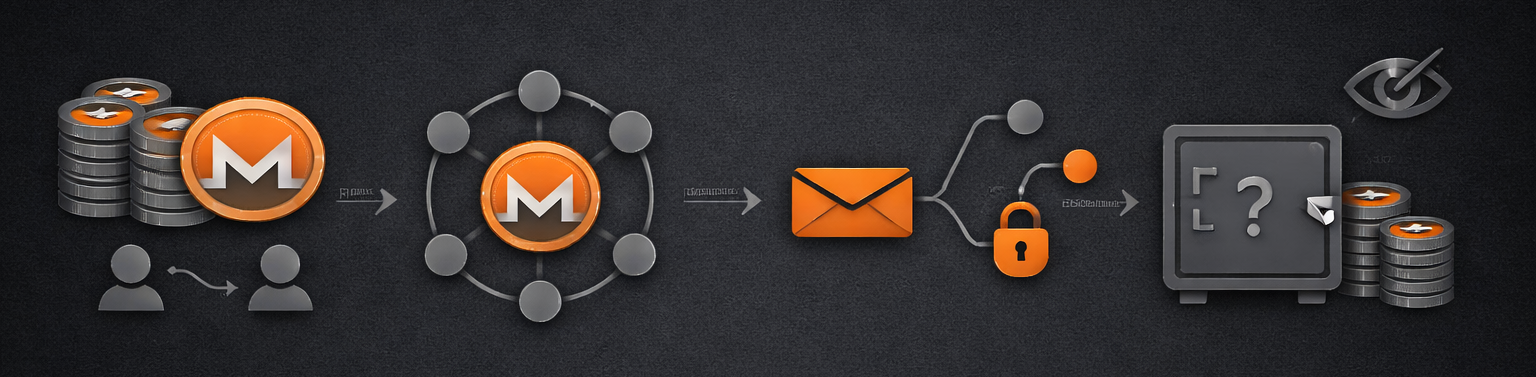
Sender privacy: ring signatures
Monero uses ring signatures to hide which output is being spent. When you spend Monero, your real output is grouped with decoy outputs from the blockchain. Observers can see that one of the outputs was spent, but not which one.
This provides plausible deniability: every transaction input looks similar to many others. Over time, this prevents reliable transaction graph analysis.
Recipient privacy: stealth addresses
To hide the recipient, Monero uses stealth addresses. The address published by the recipient is never written directly to the blockchain.
Instead, each transaction generates a one-time destination address. Only the recipient, using their private view key, can detect and spend outputs sent to them. External observers cannot link outputs to a known address.
Amount privacy: RingCT
Transaction amounts in Monero are hidden using Ring Confidential Transactions (RingCT). Amounts are cryptographically masked while still allowing the network to verify that no new coins were created.
This prevents balance tracking and stops observers from correlating transactions based on value patterns.
Network-layer privacy: Dandelion++
In addition to on-chain privacy, Monero improves transaction broadcast privacy using Dandelion++. This reduces the risk that an observer can link a transaction to the IP address that first broadcast it.
Transactions are initially relayed through a randomized path before being widely broadcast, making network-level surveillance more difficult.
For users who also want to reduce IP exposure while using exchanges or remote services, see VPNs that accept Monero.
Why Monero’s privacy is different
Monero’s key design choice is that privacy is mandatory. Because all transactions use the same privacy mechanisms, there is no “opt-in” subset that stands out.
This uniformity is critical: privacy systems work best when everyone uses them by default.
Common misconceptions
-
“Monero transactions are completely invisible.”
Transactions are visible on the blockchain, but sensitive details are cryptographically hidden. -
“Privacy is optional.”
In Monero, privacy is always on and cannot be disabled. -
“Monero relies on trust.”
Verification is still fully cryptographic and decentralized.
 monero.how